4.9
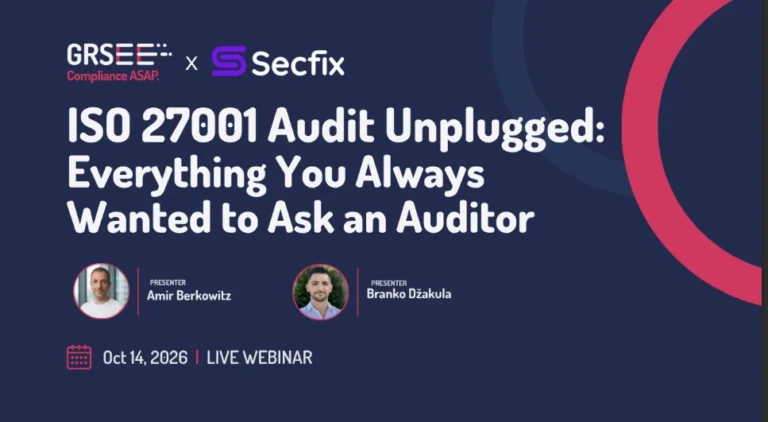
On 14 October 2026, GRSee and Secfix hosted ISO 27001 Audit Unplugged, a practical discussion about what teams should expect before, during and after an ISO 27001 audit.
Amir Berkowitz, ISO 27001 Lead Auditor at GRSee Consulting, and Branko Džakula, Co-Founder & CISO at Secfix, covered audit readiness from both sides of the table: how organizations prepare, what auditors need to verify, and what happens when they find gaps.
The central idea was simple: an ISO 27001 audit should not feel like a black box.
What we covered
The webinar addressed practical questions teams often have as an ISO 27001 audit approaches, including:
- What “audit-ready” actually means
- Whether a green compliance dashboard means you are ready
- What smooth audits tend to have in common
- What happens during Stage 1 and Stage 2
- What convinces an auditor that a control actually works
- Common findings auditors see repeatedly
- The difference between minor and major nonconformities
- What happens after certification
- How AI and newer security risks are changing audit conversations
A green dashboard does not automatically mean you are audit-ready
Completing tasks in a compliance platform is not the same as having a functioning ISMS.
A dashboard may show that policies exist, evidence has been uploaded, and controls are marked complete. But the auditor also needs to understand whether those controls are operating in practice.
That means checking whether control owners understand their responsibilities, processes are being followed, evidence reflects real operations, and the ISMS is maintained over time.
The goal is not a perfect dashboard. It is an ISMS that is genuinely being used.
What does an auditor need to see beyond a policy or screenshot?
Documentation matters, but it doesn’t always prove a control works.
A policy explains what should happen. A screenshot may show a point-in-time condition.
The auditor still needs enough evidence and context to understand whether the control operates as intended. That may include who performed the activity, when it happened, whether the process was followed, and whether the outcome matches what the organization says it does.
The question is not simply “Do you have the document?” It is:
“Can you demonstrate that the process described in the document is actually happening?”
What happens when the auditor finds a gap?
Not every issue found during an ISO 27001 audit has the same significance. The webinar discussed three common categories:
- Minor nonconformity
- An issue that needs to be addressed but does not necessarily indicate a broader management system failure.
- Major nonconformity
- A more significant issue that can indicate a serious breakdown or absence of an important requirement.
- Opportunity for improvement
- An area where the organization may strengthen the ISMS even when there is no formal nonconformity.
The important point is that a finding is not automatically a disaster. What matters is understanding the issue, its significance, and what happens next.
Audit readiness is an ongoing process
A smooth ISO 27001 audit is rarely the result of a last-minute evidence push.
Readiness is easier when the ISMS has been operating over time, responsibilities are clear, reviews happen when they should, and evidence is created as part of normal operations.
That also matters after certification. ISO 27001 does not end with the initial certification audit. Organizations must maintain and improve the ISMS through surveillance audits and future recertification.
The stronger the process, the less the organization has to reconstruct each time the auditor returns.
Make the audit less of a black box
Most audit uncertainty becomes easier to manage when expectations are clear before the audit begins. Teams should understand:
- What the auditor is trying to verify
- What evidence is likely to matter
- Which gaps need attention
- Who needs to be involved
- What happens if a finding is raised
The goal isn’t to memorize the auditor’s questions. It is to build an ISMS that can stand up to them.