What Is HITRUST CSF? Understanding Healthcare Security Compliance
HITRUST compliance plays a key role in helping healthcare organizations meet regulatory, contractual, and risk-based security requirements. Find out how the HITRUST CSF framework supports certification, streamlines compliance, and strengthens your organization’s data protection efforts.




Updated November 19, 2025
If your organization handles healthcare data, maintaining security and meeting compliance requirements is critical. HITRUST CSF simplifies this by consolidating multiple standards and regulations into a single, certifiable approach making it easier to protect sensitive information and prove your compliance.
This not only reduces the burden of meeting various requirements but also strengthens your overall security posture. In this blog, we’ll walk you through the key aspects of HITRUST CSF and how it can benefit your organization’s security and compliance journey.
» New to data security and privacy? Contact our experts for a customized and rigorous compliance audit
What Is the HITRUST CSF?
The HITRUST Common Security Framework (CSF) is a standardized, certifiable framework developed by the Health Information Trust Alliance to manage the security, privacy, and compliance of health information.
» Make sure you know about these healthcare cybersecurity trends

Build Security With Compliance
Strengthen your security posture with compliance strategies that work across every layer of your organization.
How HITRUST Goes Beyond HIPAA and HITECH
Consolidated Regulatory Framework
HITRUST CSF certification offers a unified, certifiable framework that integrates major standards like HIPAA, HITECH, NIST, ISO, PCI-DSS, and COBIT. It helps organizations identify critical systems handling sensitive data, address root causes of vulnerabilities, and implement effective risk management strategies.
By streamlining overlapping compliance efforts, HITRUST reduces redundancy and administrative burden. It also provides a consistent security baseline and improves communication of access controls across business units delivering a more comprehensive and proactive security posture than traditional healthcare regulations alone.
» Want to simplify compliance? Explore how automation beats traditional methods
Certifiable and Auditable Proof of Compliance
HITRUST offers a certifiable framework with third-party validation, unlike HIPAA and HITECH, which lack formal certification processes. This gives organizations credible proof of compliance, increasing transparency and trust with partners and regulators.
HITRUST certification also reduces reliance on vendor questionnaires and simplifies risk management. It enhances overall security, lowers compliance costs, and provides a clear path for continuous improvement. By aligning security practices with evolving threats and regulations, HITRUST helps organizations maintain strong data protection and reduce the risk of breaches.
Continuous Monitoring and Improvement
HITRUST goes beyond HIPAA and HITECH by promoting continuous improvement rather than static, point-in-time compliance. It encourages ongoing reassessment of controls, updates in response to emerging threats, and alignment with new regulations and technologies.
With features like the evolving HITRUST CSF v12 and the enhanced MyCSF platform, organizations can regularly publish and validate evidence of sustained control effectiveness. This dynamic approach supports long-term resilience and ensures security programs remain relevant, mature, and capable of meeting continuous assurance standards across various control categories.
» Learn how to get started with compliance
2 Organizations That Typically Pursue HITRUST Certification
HITRUST certification is especially important for organizations facing strict regulatory requirements, contractual obligations, or high data security risks.
1. Healthcare Providers and Health Systems
Hospitals, clinics, and other healthcare providers pursue HITRUST certification to better protect patient data and simplify the often complex world of compliance. Since they manage large amounts of sensitive health information, they must meet strict rules like HIPAA and HITECH.
Take Note: Many major health networks and insurers now require this certification, so having it helps providers build trust, reduce risk, and maintain important business relationships.
2. Health Technology Vendors (e.g., SaaS, EHR Platforms)
Health tech companies like EHR providers, cloud services, and SaaS platforms that work with healthcare clients often pursue HITRUST certification to meet both customer expectations and regulatory requirements. Their clients usually want solid proof that security and compliance are taken seriously, and HITRUST provides that assurance. It’s a widely trusted standard that can cut down on repetitive security audits.
Take Note: Being HITRUST certified helps companies manage risk, stand out in a competitive market, and more easily win healthcare-related contracts and partnerships.
» Make sure you know about these cybersecurity risks and problems in healthcare
Your Partner in Cybersecurity
Every organization faces different risks, so we customize our strategies to fit your industry, compliance requirements, and security goals.
The Three HITRUST CSF Assessment Levels
Each HITRUST CSF assessment level serves a distinct purpose based on an organization’s size, risk exposure, and maturity in cybersecurity and compliance.
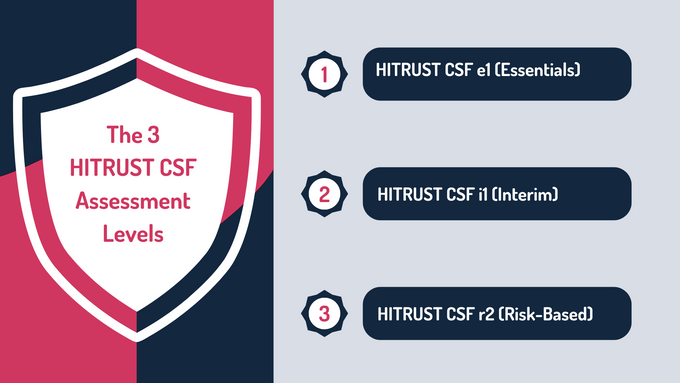
1. HITRUST CSF e1 (Essentials)
The e1 (Essentials) assessment is meant for organizations with lower-risk environments or those starting their cybersecurity and compliance efforts. It focuses on basic security controls and a simplified set of HITRUST CSF requirements. While it's not as detailed as other assessments, it still provides a clear framework to ensure essential security measures are in place.
Key factors:
- Designed for smaller or lower-risk organizations.
- Covers basic controls related to confidentiality, integrity, and access.
- Supports fundamental compliance without complex measures.
- Requires fewer resources to implement.
2. HITRUST CSF i1 (Interim)
The i1 (Interim) assessment is designed for organizations seeking a higher level of assurance than the e1 but without committing to the full, rigorous certification. It covers a wider range of HITRUST CSF controls and is perfect for organizations in transition or those wanting to show progress.
Key factors:
- External validation is required to confirm the implementation of these controls.
- This level helps demonstrate meaningful progress toward comprehensive risk management.
3. HITRUST CSF r2 (Risk-Based)
The r2 (Risk-Based) assessment is the most thorough and well-recognized HITRUST certification level. It includes a detailed evaluation of an organization’s security controls, governance, and risk management practices across many HITRUST CSF domains.
Key factors:
- Organizations seeking this level must undergo a strict third-party assessment to validate the effectiveness of their controls.
- Ideal for larger organizations, particularly those handling critical or sensitive information, to ensure their security practices are robust and well-documented.
Remember: As an organization grows and faces evolving risks and regulatory requirements, it may need to transition from the e1 or i1 assessments to the r2 to meet more demanding standards and ensure long-term security.
» Boost your organization's cybersecurity with the CIA triad
4 Phases of the HITRUST CSF Certification Process
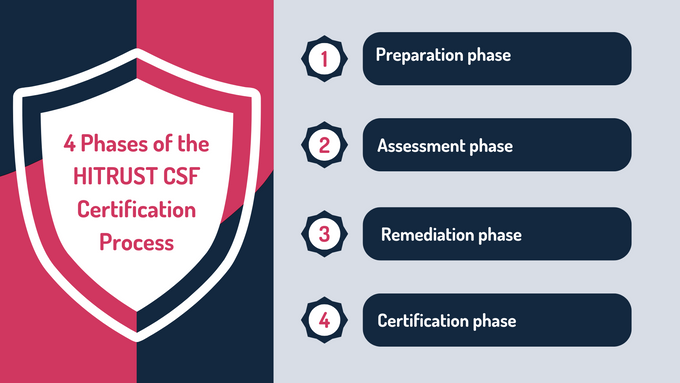
1. Preparation Phase
During the preparation phase, organizations assess their current security measures and identify any gaps compared to HITRUST CSF requirements. Healthcare organizations typically start by choosing the right assessment level (e1, i1, or r2) based on their size, risk profile, and regulatory needs.
This phase involves:
- Internal audits
- Gathering relevant documentation
- Creating a compliance roadmap
2. Assessment Phase
In the assessment phase, healthcare organizations go through a formal evaluation to determine how well their security controls align with HITRUST CSF standards. A certified third-party assessor conducts a detailed review, examining policies, procedures, and technical controls to ensure they meet the required criteria. Organizations must provide thorough documentation and evidence showing that security measures are effectively implemented.
3. Remediation Phase
Following the assessment, organizations often enter the remediation phase to fix any weaknesses or gaps uncovered during the evaluation.
This phase involves:
- Strengthening security controls
- Updating policies
- Making technical improvements to align fully with HITRUST CSF standards
Healthcare organizations should focus first on areas where controls were found lacking. Clear and ongoing communication between internal teams and external assessors is essential to ensure that all necessary improvements are correctly implemented and documented.
4. Certification Phase
After completing remediation and putting all necessary controls in place, organizations submit their final evidence to HITRUST for review. A third-party assessor conducts a final validation to confirm that all HITRUST CSF requirements have been met.
Certification & Compliance: If the organization passes, it receives HITRUST CSF certification, which is valid for two years. To maintain compliance, organizations should also plan for ongoing monitoring, updates, and periodic reviews throughout the certification period.
» Concerned about healthcare cybersecurity risks? Discover the vulnerabilities threatening patient care
HITRUST Scoring Methodology
HITRUST uses a maturity-based scoring system to assess how well an organization meets required security controls. Each control is evaluated across five levels:
- Policy: This level ensures that documented security policies are established and approved by the organization.
- Procedure: At this stage, detailed procedures are defined to guide how security policies should be followed.
- Implemented: This means the procedures are actively put into practice throughout the organization.
- Measured: Here, the effectiveness of the implemented controls is tracked and assessed regularly.
- Managed: The highest level involves continuous monitoring and improvement of controls to maintain strong, ongoing security.
Scores are given on a scale from 0 to 100%, with greater weight placed on the higher maturity levels. To earn HITRUST r2 certification, organizations must score at least 62% in every domain and meet the “Implemented” level for all required controls.
How We Help You Achieve HITRUST Compliance
At GRSee, we guide you through every step of the HITRUST CSF certification process, starting with a readiness assessment to identify gaps and select the right certification level for your organization. We help you develop policies, implement technical controls, and prepare all necessary documentation. Our team runs thorough mock assessments to ensure you are fully prepared for the official audit, reducing surprises and boosting confidence.
Beyond certification, we provide ongoing support through continuous monitoring, timely regulatory updates, and strategic advice tailored to your needs. With GRSee by your side, you can confidently achieve and maintain HITRUST compliance, continuously improving your security posture and risk management over time.
» Contact us to ensure your organization meets compliance with robust security strategies