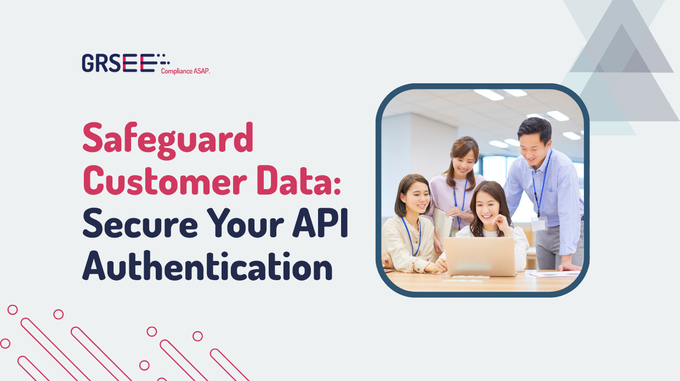
How to Secure API Authentication and Authorization in SaaS Apps
Learn how to secure your SaaS APIs with OAuth 2.0 best practices, JWT lifecycle management, and multi-layered security controls that protect against authenticated session attacks and authorization failures.




Updated March 18, 2026
AI Summary


API security incidents hit 84% of organizations in 2024. What's more concerning is that 95% of these attacks originated from authenticated sessions, meaning attackers weren't breaking in through the front door but exploiting legitimate access.
For SaaS applications where APIs handle everything from user data to payment processing, weak authentication and authorization controls create direct paths to sensitive information. In this blog, we will explore what API authentication and authorization mean and why they're critical.
» Looking for an effective security solution for your business? Contact us
What Is API Authentication And Authorization?
API authentication answers the question "who are you?" It verifies the identity of a user, service, or application attempting to access your API. This typically involves credentials like API keys, tokens, or certificates that prove identity before granting access.
Authorization answers "what can you do?" Once identity is confirmed, authorization determines which resources the authenticated party can access and what actions they can perform. A user might be authenticated to access your system but only authorized to view certain data, not modify or delete it.
To Summarize: These two concepts work hand in hand. Authentication without proper authorization leaves your system vulnerable to privilege escalation, where authenticated users access resources beyond their permissions. Authorization without strong authentication means you're controlling access for identities you can't trust.
» Have a startup? Here are some cyber tips for your startup business
The Importance Of API Authentication And Authorization
- Protecting sensitive data: APIs often serve as direct conduits to your most valuable data, customer information, financial records, and proprietary business logic. Without proper authentication and authorization, this data becomes accessible to anyone who discovers your API endpoints.
- Maintaining regulatory compliance: Regulations like SOC 2, ISO 27001, and PCI DSS explicitly require strong access controls. Failing to implement proper API security can result in failed audits, lost certifications, and regulatory penalties.
- Preventing unauthorized access at scale: Unlike traditional applications, where users interact through a UI, APIs enable programmatic access. A single compromised API key or token can allow attackers to make thousands of requests per second, extracting data or abusing functionality far faster than any human could.
- Preserving multi-tenant isolation: In SaaS environments, multiple customers share the same infrastructure. Proper authorization ensures Tenant A cannot access Tenant B's data, a fundamental requirement for customer trust and legal compliance.
- Reducing breach costs: The average data breach costs $4.88 million, and API vulnerabilities rank among the top entry points for attackers. Strong authentication and authorization serve as your first and most critical line of defense.
» Don’t leave it too late: Explore the disasters you can avoid by proactively addressing your cybersecurity needs
Essential Security Layers For Multi-Layered API Security
Securing APIs requires thinking in layers rather than relying on single defenses. Each layer addresses different attack vectors and provides backup if another layer fails.
- Strong authentication layer: Use short-lived tokens instead of static API keys. Implement multi-factor authentication for user-facing APIs. Deploy risk-based authentication that adapts to unusual login patterns or locations. This layer ensures you know who or what is making the request.
- Fine-grained authorization layer: Implement role-based or attribute-based access controls that enforce minimum necessary permissions. Separate tenant data strictly in multi-tenant environments. Validate authorization at every API endpoint, not just at login. This layer ensures authenticated parties only access what they should.
- Input validation and schema enforcement layer: Validate all incoming data against defined schemas before processing. Sanitize inputs to prevent injection attacks. Reject malformed requests immediately. This layer prevents attackers from exploiting API logic through manipulated data.
- Rate limiting and throttling layer: Set request limits per user, per endpoint, and per time period. Implement anomaly detection to identify unusual usage patterns. Block or challenge suspicious activity automatically. This layer prevents brute force attacks and API abuse at scale.
- Encryption layer: Encrypt all data in transit using TLS 1.2 or higher. Encrypt sensitive data at rest. Use secure key management practices. This layer protects data even if other defenses fail.
- API gateway and WAF layer: Centralize policy enforcement through API gateways. Deploy web application firewalls to filter malicious traffic. Monitor and log all API activity. This layer provides consistent security across all endpoints and visibility into threats.
- Continuous monitoring layer: Log authentication attempts, authorization decisions, and API usage patterns. Feed logs into SIEM systems for correlation and alerting. Monitor for indicators of compromise in real time. This layer enables early detection of attacks in progress.
» Exposed ports and weak firewalls invite attackers. Identify security gaps before attackers do
How to Secure API Authentication and Authorization in SaaS Apps
OAuth 2.0 Implementation Challenges and RFC 9700 Updates
OAuth 2.0 is the backbone of API authentication in SaaS apps, but real-world deployments expose recurring issues. Many teams struggle with securely handling redirect URIs, enforcing Proof Key for Code Exchange (PKCE) across all clients, and rotating refresh tokens without breaking user sessions.
Others still rely on older flows like implicit or resource owner password credentials, both of which create significant risks. Balancing token lifetimes—short for security, long for usability—also proves difficult, especially in multi-service environments.
RFC 9700 makes several of these best practices mandatory:
- Implicit and password grants are deprecated.
- Authorization Code with PKCE is now required for all clients.
- Refresh tokens must be rotated with reuse detection.
- Access tokens should be sender-constrained (via DPoP or mTLS).
For older systems, this means migrating to modern, short-lived tokens with stricter validation processes.
» Discover how to fortify your business against password spraying attacks
Managing the JWT Token Lifecycle
In high-volume SaaS environments, the way you issue, store, use, and revoke JSON Web Tokens (JWTs) directly impacts both security and scalability. Tokens should never be treated as permanent credentials—every stage of their lifecycle needs strict controls.
Best practices for each stage:
- Issuing tokens: Generate tokens only from a trusted authorization server. Keep access tokens short-lived (a few minutes) so stolen tokens quickly expire. Sign them with strong algorithms like RS256 or ES256, and only include the claims you actually need.
- Storing tokens: On the client side, keep access tokens in memory rather than localStorage to reduce exposure to XSS. Refresh tokens, if used, should go into secure, HTTP-only cookies.
- Using tokens: Every API request should validate the token’s signature, issuer, audience, expiration, and scopes. Design claims so users only get the minimum access they need. To reduce replay risk, consider sender-constrained tokens (DPoP or mTLS).
- Refreshing and revoking: Rotate refresh tokens and detect reuse. Provide a reliable revocation endpoint. Finally, log token usage and monitor for unusual activity to catch attacks early.
mTLS for API Authentication
Mutual TLS (mTLS) adds a strong layer of trust by requiring both the client and server to authenticate using digital certificates. While highly secure, it introduces operational complexity—mainly around certificate management.
Key considerations include:
- Setting up a solid PKI with trusted certificate authorities.
- Automating certificate issuance and rotation (via SPIFFE/SPIRE, ACME, or service meshes).
- Protecting private keys in secure modules like HSMs or cloud KMS.
- Ensuring certificates map correctly to application roles, since mTLS confirms identity but not authorization.
Take note: mTLS shines in high-trust scenarios such as service-to-service communication, partner APIs, or regulated industries. However, for consumer-facing applications, OAuth 2.0 is often more practical due to ease of integration.
Applying Zero Trust Principles to SaaS APIs
Zero trust shifts the model from “inside is safe” to “always verify.” For APIs, this means every request must undergo identity, authorization, and context checks—regardless of origin. Implementing this in SaaS systems requires layering authentication, authorization, and monitoring into the entire API lifecycle.
Core practices include:
- Using short-lived tokens and multi-factor authentication.
- Granting only the minimum privileges necessary.
- Employing an API gateway or service mesh to centralize authentication and policy enforcement.
- Continuously monitoring requests to detect unusual or malicious activity.
The biggest challenge lies in modernizing legacy systems that still depend on perimeter defenses. A phased approach—starting with OAuth/OIDC consolidation and adding gateway-based enforcement—helps build zero trust gradually without blocking developers.
Compliance and Governance in API Security
Different industries impose different compliance requirements, but the fundamentals—data protection, access control, and auditability—remain consistent. Financial services must align with PCI DSS, healthcare providers with HIPAA, and companies handling EU data with GDPR.
On top of that, many SaaS organizations pursue SOC 2 or ISO 27001 to strengthen governance and customer trust.
Strong API Governance in Practice Looks Like:
- Maintaining an inventory of APIs with clear ownership.
- Enforcing standards for authentication, authorization, and encryption.
- Implementing consistent versioning and change review policies.
- Monitoring traffic in real time, applying rate limits, and detecting anomalies.
- Having incident response playbooks for token revocation, key disabling, and endpoint blocking.
This governance-driven approach ensures that compliance obligations are met while improving visibility and resilience across the API ecosystem.
» Make sure you understand the difference between asymmetric and symmetric encryption

Expert Pentesting
Uncover and address security weaknesses in your organization through GRSee’s specialized penetration testing approach.
Building A Secure API Foundation For Your SaaS
API authentication and authorization form the foundation of SaaS security, requiring a layered approach that combines OAuth 2.0 with RFC 9700 requirements, proper JWT lifecycle management, and continuous monitoring. The key principle remains constant: verify identity at every request, enforce least-privilege access, and monitor continuously for anomalies.
We at GRSee can help your business implement comprehensive API security controls, achieve compliance with SOC 2 and ISO 27001 standards, and build security frameworks that accelerate rather than block your growth.
» Ready to boost your organization's security? Contact us to learn more
FAQs
Why are most API attacks coming from authenticated sessions?
Because attackers often exploit valid credentials or tokens, allowing them to operate as legitimate users. This makes it harder to detect intrusions since the activity appears authorized on the surface.
What’s the main difference between authentication and authorization?
Authentication verifies who is accessing your API, while authorization defines what they’re allowed to do once authenticated. Both are essential—one without the other leaves systems exposed.
What role does Zero Trust play in API security?
Zero Trust ensures every API request is verified, authorized, and monitored—no matter where it originates. It removes the assumption that internal traffic is safe, protecting APIs from insider and lateral attacks.
How can SaaS companies strengthen API security and compliance?
By combining layered defenses—like strong authentication, fine-grained authorization, encryption, and continuous monitoring—with compliance frameworks such as SOC 2 and ISO 27001. This not only improves resilience but also builds customer trust.