How to Prove Compliance Isn’t Just a Cost, It’s a Growth Engine
Compliance is your competitive edge. Discover how measuring its impact in your CRM turns security audits into a powerful engine for business growth and accelerated deals.




Published December 2, 2025
There’s a quiet moment that happens in nearly every B2B sales process. The deal is going well, the demo landed perfectly, and the decision-maker is nodding. Then someone asks:
Then someone asks:
The room changes. The deal is suddenly on pause. Not because of your product, but because of trust. That moment is where compliance either becomes a bottleneck or a business enabler. And that’s where the real ROI of compliance lives.
» Contact us to strengthen your cybersecurity strategy with expert compliance services
Why Compliance ROI Matters
For many companies, compliance feels like an expense, something you have to do to keep clients happy. But when measured correctly, it’s one of the clearest signs of business maturity and a reliable driver of growth. Compliance isn’t just about passing an audit.
It’s about proving you can be trusted; with data, with clients, and with scale. That trust shortens sales cycles, opens doors to bigger deals, and lets your team spend less time answering vendor questionnaires and more time building your product.
So, how do you measure it?
Start Where It Counts: Your CRM
If you’re not already tracking compliance impact in your CRM, start today.
Add a few checkboxes or fields for every opportunity:
- Was compliance a client requirement?
- Was our compliance status a deal accelerator?
Over time, this simple tracking will show you:
- The percentage of deals that required certification
- The total pipeline value tied to compliance
- The win rate when your company was already certified
» Learn more: What is good compliance and how to get started?
Track Sales Efficiency, Not Just Wins
Compliance builds confidence. Confidence closes deals faster.
Look at these metrics before and after certification:
- Average sales cycle: Are deals closing faster now that you’re certified?
- Objection rate: How often do prospects request additional security assurances?
- RFP performance: Are you winning more tenders that include compliance requirements?
This isn’t just theory. We’ve seen clients cut weeks off their enterprise sales cycle simply by being able to attach their SOC 2 report on day one.
Measure Marketing Lift
Compliance don’t just influence buyers in meetings, they influence them before you ever speak.
Track how compliance messaging affects marketing performance:
- Traffic growth to compliance-related case studies or landing pages
- Lead quality when visitors come through compliance content or keywords
If your compliance badge helps prospects trust you faster, that’s measurable ROI, in brand credibility, lead quality, and inbound conversions.
» Understand the disasters you can avoid by tackling cybersecurity on time
Capture Operational Efficiency
A compliant company is a more structured company. And structure saves time, money, and headaches.
Some measurable operational ROI indicators include:
- Time saved responding to vendor security questionnaires thanks to pre-existing certifications
- Reduction in ad-hoc audits from clients or partners
- Streamlined vendor onboarding (you move up their trust list automatically)
- Fewer incidents or vulnerabilities due to stronger controls
Your compliance framework becomes a built-in efficiency engine; one that keeps paying dividends long after the audit ends.
Calculate Financial ROI
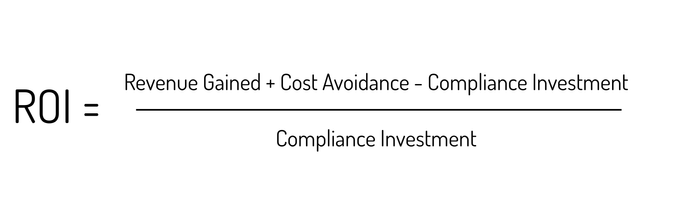
- Revenue gained: Deals or renewals enabled by compliance
- Cost avoidance: Savings from fewer client audits, reduced breach risk, and operational efficiency
- Investment: Your certification and audit costs
Don’t Overlook Strategic ROI
Some benefits are less visible but equally powerful:
- Partnership opportunities with enterprise vendors or platforms
- Investor confidence and smoother due diligence
Compliance doesn’t just check boxes, it builds credibility that compounds over time.
» Read how Rewire turned security compliance into a competitive advantage with GRSee

Turn Compliance Into a Growth Engine
GRSee helps you capture the benefits of compliance, from efficiency gains to faster sales cycles.
The GRSee Way: Measuring What Matters
At GRSee, we’ve helped hundreds of SaaS and tech companies turn compliance from a cost into a catalyst. Our white-glove, high-touch approach goes beyond templates and checklists, we help you align compliance with business outcomes. We believe compliance should simplify, not complicate. It should unlock growth, not slow it down. And it should always deliver measurable results, in trust, in efficiency, and in revenue.
That’s The GRSee Way: Simplify the complex. Deliver with care. Turn compliance into your competitive advantage.
» Ready to quantify your compliance ROI? We’ll help you track it, prove it, and use it to fuel your next stage of growth
FAQs
How can compliance shorten our sales cycle?
Compliance certifications (like SOC 2 or ISO 27001) act as an instant trust signal. By proactively providing these on day one, your sales team bypasses lengthy security review questionnaires and due diligence processes required by prospects, directly accelerating the time it takes to close a deal.
What is the most important metric to track in our CRM related to compliance?
The most crucial metric is the pipeline value tied to compliance. This shows the total potential revenue from deals where a specific certification (e.g., HIPAA for healthcare) was a mandatory requirement.
Tracking the win rate for these certified deals is also essential to quantify the direct revenue gain from your investment.
Is the only benefit of compliance avoiding fines and breaches?
No. While risk mitigation is a core function, the ROI extends significantly into growth. The benefits include::
- Revenue enablement (accessing new markets/deals)
- Sales efficiency (faster cycle times)
- Operational efficiency (streamlining internal processes and vendor questionnaires)
- Marketing lift (enhanced brand credibility and lead conversion)
What is "Strategic ROI" and why shouldn't we overlook it?
Strategic ROI refers to the less visible but powerful long-term benefits of compliance that unlock new business capabilities.
Examples include access to regulated industries (like finance or government), attracting top-tier partners (AWS, Salesforce integrations), and increasing investor confidence during funding rounds or mergers/acquisitions.